

PCD is not one uniform condition.
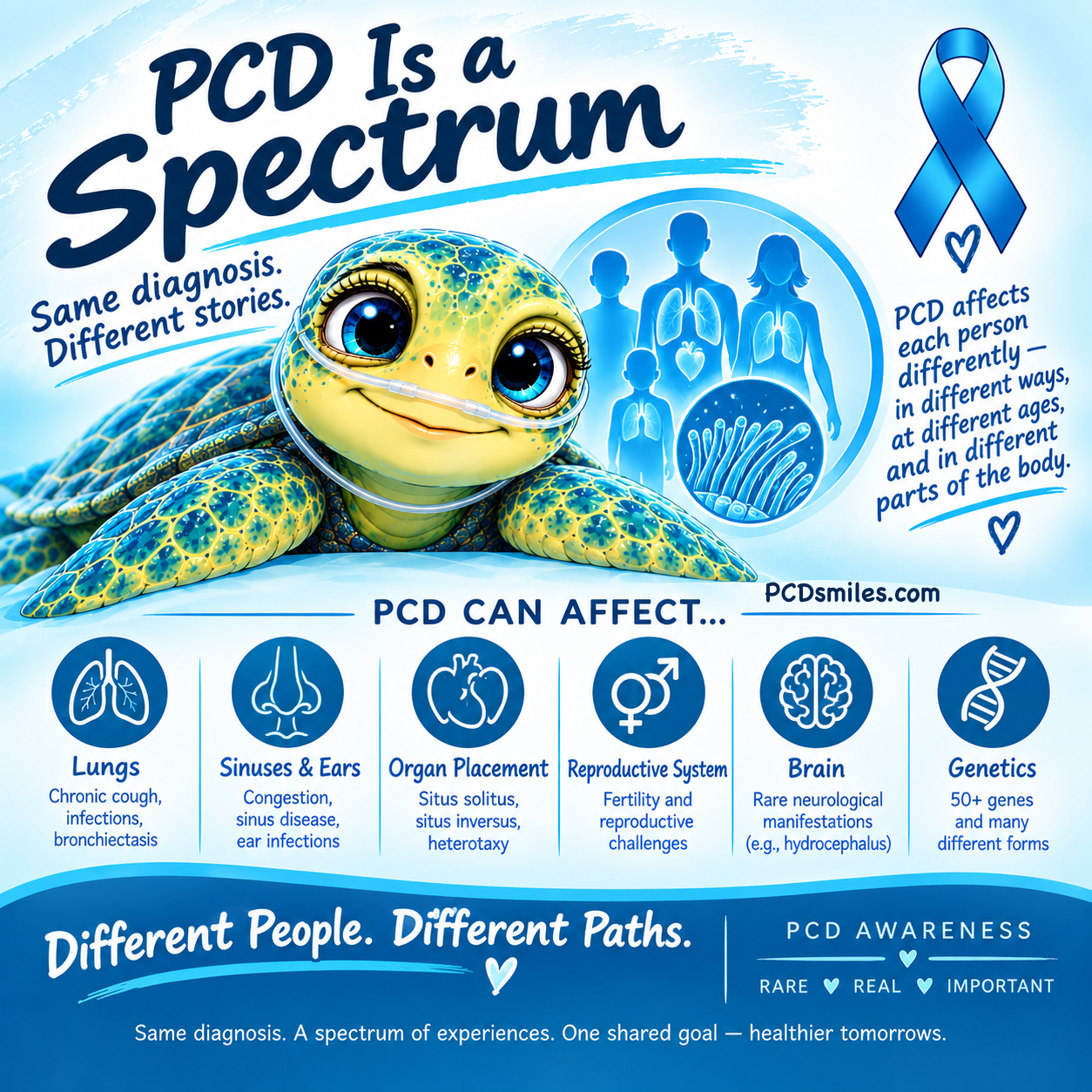
More than 50 different genes have been associated with PCD, and these genes can affect the structure, assembly, or movement of cilia in different ways.
As a result, two people with PCD may have very different symptoms, disease severity, and complications.
One person may have severe respiratory problems beginning shortly after birth, while another may
not receive a diagnosis until adulthood.
The diagnosis may be the same, but the experience of PCD can be very different.
Respiratory Symptoms Can Range Widely
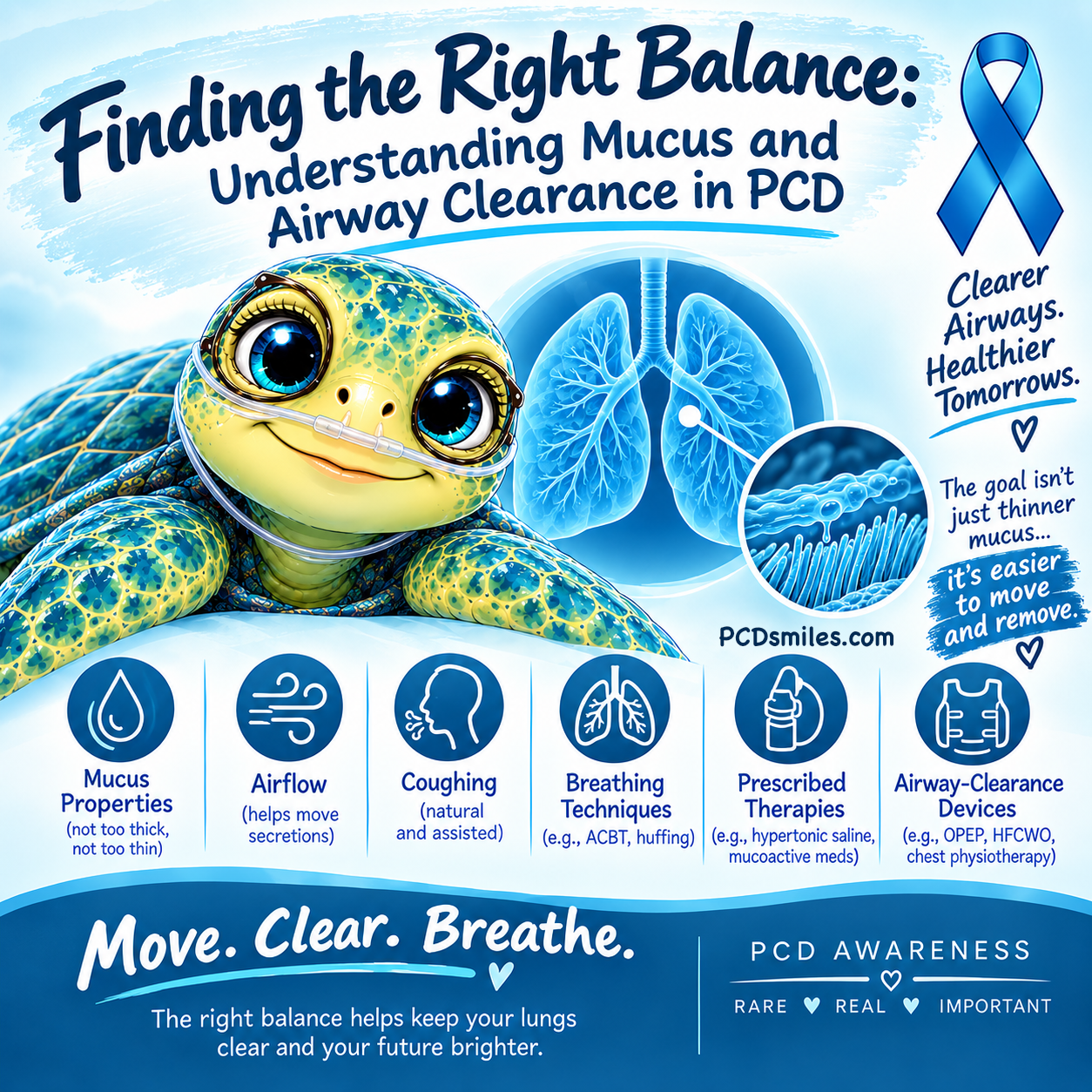
Because the cilia in the respiratory tract normally help move mucus and particles out of the airways, abnormal ciliary function can lead to problems with mucus clearance.
Common respiratory manifestations can include:
- A persistent or daily wet cough
- Chronic nasal congestion or sinus disease
- Recurrent sinus infections
- Repeated ear infections
- Recurrent respiratory infections
- Difficulty clearing mucus
For some children, respiratory problems can be apparent from the very beginning of life.
Neonatal respiratory distress can occur in some infants with PCD, even when they were born at or near term.
For others, the symptoms may initially seem less severe and can be mistaken for more common childhood conditions.
Over time, repeated infection, inflammation, and impaired mucus clearance can contribute to permanent changes in the airways known as bronchiectasis.
Bronchiectasis involves widening and structural remodeling of the bronchial airways and can make mucus clearance even more difficult.
PCD Can Also Affect Organ Placement
PCD isn't limited to the lungs.
Motile cilia play important roles during early development, including processes that help establish the normal left-right arrangement of the body's internal organs.
As a result, approximately half of people with PCD have some form of abnormal organ laterality.
This can include:
- Situs solitus — the usual arrangement of the internal organs
- Situs inversus — a mirror-image arrangement of some or many organs
- Situs ambiguus/heterotaxy — a more complex or unusual arrangement of organs
When a person has situs inversus, along with chronic sinus disease and bronchiectasis, the combination has historically been called Kartagener syndrome.
Importantly, not everyone with PCD has reversed organs, and having normal organ placement does not rule out PCD.
The Effects Can Extend Beyond the Lungs
The respiratory system isn't the only area affected by dysfunctional cilia.
PCD can also involve the ears and sinuses, which helps explain why some people experience chronic ear disease and sinus problems from childhood.
Ciliary dysfunction can also affect the reproductive system.
Depending on the individual, PCD may be associated with fertility or reproductive challenges.
These manifestations are another reminder that PCD is much more than a lung disease.
What About the Brain?
Cilia are involved in several biological processes throughout the body.
Some sources have reported rare neurological manifestations, including hydrocephalus, or an accumulation of fluid within the brain.
However, this is not a typical feature of PCD and appears to be uncommon.
Why Can PCD Be So Difficult to Recognize?
One of the biggest challenges with PCD is that many of its symptoms can look like much more common conditions.
A child with chronic congestion might be thought to have allergies.
A persistent cough might be attributed to asthma.
Repeated respiratory infections might simply be viewed as a child who "gets sick a lot."
Some symptoms can also overlap with other genetic or respiratory diseases, including cystic fibrosis.
As a result, some people with PCD can go years—or even decades—before receiving a diagnosis.
Recognizing the Warning Signs
Awareness of the characteristic pattern of PCD can help healthcare professionals recognize when further evaluation may be appropriate.
Potential clues can include combinations such as:
- Respiratory distress in a newborn born at or near term
- A chronic wet cough beginning early in childhood
- Year-round nasal congestion
- Chronic or recurrent sinus disease
- Recurrent ear infections
- Repeated pneumonia or other respiratory infections
- Bronchiectasis without an obvious explanation
- Abnormal organ placement
- Certain reproductive or fertility problems
No single symptom proves that someone has PCD.
But when several of these features occur together, they may provide an important reason to consider further evaluation.
Why Earlier Recognition Matters
Identifying PCD can be challenging, and diagnosis may require specialized testing.
Depending on the individual, evaluation may involve tests that examine ciliary structure and function, measurements such as nasal nitric oxide, and genetic testing.
No single test identifies every person with PCD.
Recognizing the possibility of PCD earlier can nevertheless help connect patients with healthcare professionals who understand the condition and can develop an appropriate long-term management plan.
That may include individualized airway-clearance therapy, monitoring of lung health, treatment of respiratory infections, and management of other manifestations of the disease.
There Isn't One "Typical" Person With PCD
Perhaps one of the most important things to understand about PCD is this:
There is no single PCD story.
One person may have severe disease beginning in infancy.
Another may have years of sinus and ear problems before anyone recognizes the underlying cause.
Someone else may not receive a diagnosis until adulthood.
Some people have abnormal organ placement.
Others have completely typical organ placement.
Some develop significant bronchiectasis.
Others may have less extensive lung involvement.
These differences don't make one person's PCD more "real" than another's.
They demonstrate just how genetically and clinically diverse PCD can be.
Why PCD Awareness Matters
PCD may be rare, but the consequences of delayed recognition can be significant.
When chronic respiratory symptoms are repeatedly treated as unrelated problems, the underlying cause can remain hidden.
Greater awareness can help patients, families, and healthcare professionals recognize patterns that might otherwise be overlooked.
And sometimes, recognizing that pattern is the first step toward getting the right testing, diagnosis, monitoring, and treatment.
PCD may be caused by microscopic problems with cilia—but its effects can reach far beyond the microscopic world.
Understanding the spectrum of PCD means recognizing that this condition can affect people differently, at different ages, and in different parts of the body.
Be sure to join us tomorrow for another conversation about primary ciliary dyskinesia.
Join our Facebook group Turtle Talk Café today.
We have several ways that you can donate to PCD Smiles;
- Visit Smile E. Turtle's Amazon Wishlist
- For more information on how you can donate, please visit our "Donation" page to check out our "Do & Don't policies.
- Or sponsor a PCD Smiles cheer package today!
- To shop for your “Official” turtle care ribbon gear today, visit PCD Style
Thank you for your consideration!
Medical Disclaimer
This article is intended for general educational and informational purposes only and is not a substitute for professional medical advice, diagnosis, or treatment. Infection risks and appropriate prevention strategies can vary considerably between people with PCD based on their lung health, respiratory cultures, treatments, age, and other medical conditions.
This article is for educational purposes and does not establish that over-thinning mucus causes increased infection risk in people with PCD. Responses to airway-clearance and mucoactive therapies vary. Any changes to prescribed treatments should be discussed with a healthcare professional familiar with PCD.
Cleaning and disinfection recommendations for respiratory equipment can also vary by device and manufacturer. Always follow the instructions provided by your healthcare team and equipment manufacturer.
Do not start, stop, or change medications, airway-clearance treatments, infection-control practices, or other aspects of your medical care based solely on this article. If you have PCD and are concerned about an infection, worsening respiratory symptoms, or possible exposure to a pathogen, contact your PCD or respiratory healthcare team for individualized guidance.
If you are experiencing severe or rapidly worsening breathing difficulties or another medical emergency, seek urgent medical attention.