


When people think about Primary Ciliary Dyskinesia (PCD), they often think of chronic cough, recurrent respiratory infections, sinus problems, and the daily work required to keep mucus moving.
PCD is a lifelong genetic condition in which abnormal or dysfunctional cilia interfere with the body's ability to clear mucus, bacteria, and other particles from the respiratory tract.
But there is a lesser-known phenomenon described within
the PCD community that can be especially confusing for young adults: what is sometimes called the “Cinderella Phase.”
It describes a period when someone with PCD may feel dramatically better—even though the underlying condition has not gone away.
And that difference is important.
What Is the “Cinderella Phase”?
The term “Cinderella Phase” has been used to describe a period, often reported from the late teens or early twenties into the twenties or early thirties, when some people with PCD experience a noticeable reduction in symptoms.
Someone who spent childhood dealing with:
- Frequent ear infections
- Chronic sinus problems
- A persistent wet cough
- Recurrent respiratory infections
- Regular airway-clearance treatments
may suddenly begin feeling much healthier.
Their cough may become less noticeable. Their sinuses may seem better. Respiratory infections may occur less frequently.
For a young adult who has spent years managing PCD, this can feel like finally being “normal.”
It can even lead to the understandable belief that perhaps the condition has improved—or that the original diagnosis was somehow wrong.
But feeling better doesn't necessarily mean the underlying problem has disappeared.
When Feeling Better Can Be Misleading
The most important concept behind the Cinderella Phase is:
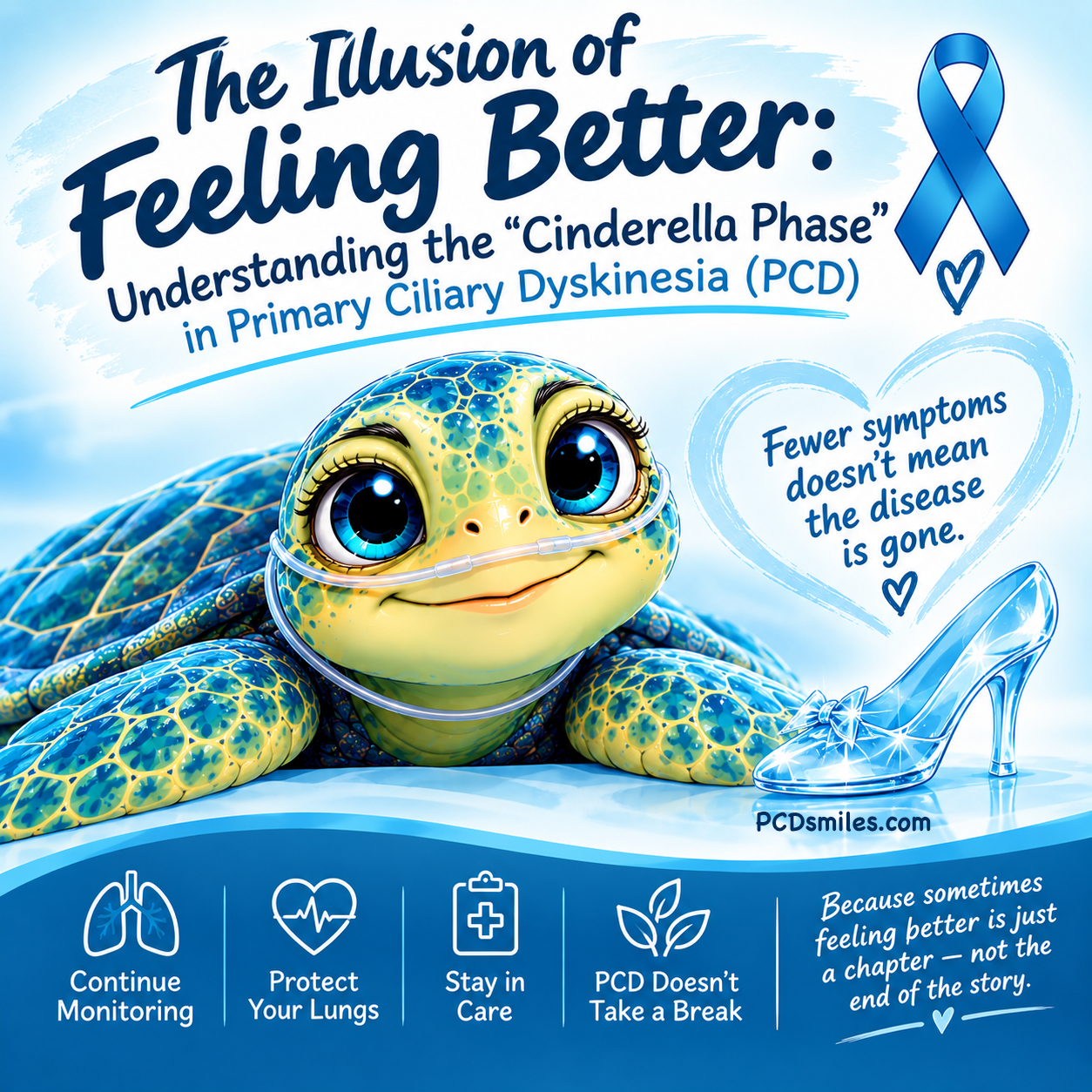
Fewer symptoms do not necessarily mean the disease has gone away.
PCD is caused by genetic changes affecting ciliary structure or function. A period of improved symptoms does not mean those genetic changes have been corrected.
The exact reason some people experience this apparent period of improvement is not fully understood yet..
What is important is recognizing that symptoms and underlying disease activity are not always the same thing.
A person can feel better while still having impaired mucus clearance.
The Risk of Letting Your Guard Down
When someone finally feels well after years of respiratory problems, it is completely understandable that they might want to step away from treatments that have become a major part of daily life.
That can include:
- Stopping or reducing airway-clearance treatments
- Using nebulized therapies less frequently
- Missing routine specialist appointments
- Assuming medical follow-up is no longer necessary
But if the underlying ciliary dysfunction remains, mucus clearance can still be impaired.
The absence of obvious symptoms doesn't necessarily tell you what is happening deeper inside the lungs.
This is one reason ongoing monitoring and individualized treatment remain important.
What Could Be Happening Beneath the Surface?
PCD can create a cycle involving:
Impaired ciliary movement → mucus retention → infection and inflammation → airway injury → progressive lung damage
Over time, repeated infection and inflammation can contribute to structural changes in the airways, including bronchiectasis.
Bronchiectasis involves permanent widening and remodeling of the bronchial airways.
One of the concerns surrounding the Cinderella Phase is that someone may feel significantly better while underlying lung disease continues to develop or progress.
The person may not necessarily feel the changes happening.
That is why symptoms alone cannot always tell the entire story of lung health.
Why Follow-Up Still Matters
Feeling better is wonderful.
But for someone with PCD, feeling better can be an opportunity to continue protecting the lungs—not a reason to assume PCD has disappeared.
Regular follow-up with healthcare professionals familiar with PCD can help monitor lung health and determine whether treatment needs to continue or change.
Depending on the individual, monitoring may include assessments of lung function, respiratory symptoms, infections, and other aspects of PCD.
The goal isn't to treat someone unnecessarily.
The goal is to understand what is happening even when the person feels well.
When the “Magic” Seems to Wear Off
The Cinderella analogy comes from the idea that the period of feeling better may eventually end.
For some people, respiratory symptoms may become more noticeable again later in adulthood.
A returning cough, increased mucus, recurrent infections, worsening sinus symptoms, or declining exercise tolerance can be signs that something has changed and deserves medical attention.
But it's important not to assume that every person with PCD will experience a predictable Cinderella Phase or that symptoms will inevitably return at a particular age.
PCD affects people differently.
The term describes a reported phenomenon, not a universal stage that every person with PCD will experience.
PCD Doesn't Take a Break
Perhaps the most important message is simple:
Feeling better doesn't necessarily mean PCD is gone.
PCD is a lifelong genetic condition. Even when symptoms become quieter, the underlying ciliary dysfunction remains.
That means periods of feeling well can be especially valuable—but they shouldn't necessarily mean abandoning the care that helps protect lung health.
Instead, they can be an opportunity to enjoy feeling better while continuing appropriate monitoring and treatment.
The Bigger Picture
The “Cinderella Phase” is an important concept because it highlights something that can be easy to overlook:
How someone feels and what is happening inside their lungs aren't always the same thing.
For a person who has spent years coughing, fighting infections, and performing daily airway clearance, finally feeling better can be life-changing.
But PCD doesn't necessarily disappear simply because the symptoms become quieter.
Understanding that distinction can help people with PCD, families, and healthcare providers recognize the importance of continued follow-up and individualized care.
Sometimes the most important time to protect your lungs is when you feel like you don't need to.
Be sure to join us tomorrow for another conversation about primary ciliary dyskinesia.
Join our Facebook group Turtle Talk Café today.
We have several ways that you can donate to PCD Smiles;
- Visit Smile E. Turtle's Amazon Wishlist
- For more information on how you can donate, please visit our "Donation" page to check out our "Do & Don't policies.
- Or sponsor a PCD Smiles cheer package today!
- To shop for your “Official” turtle care ribbon gear today, visit PCD Style
Thank you for your consideration!
Medical Disclaimer
This article is intended for general educational and informational purposes only and is not a substitute for professional medical advice, diagnosis, or treatment. Infection risks and appropriate prevention strategies can vary considerably between people with PCD based on their lung health, respiratory cultures, treatments, age, and other medical conditions.
Cleaning and disinfection recommendations for respiratory equipment can also vary by device and manufacturer. Always follow the instructions provided by your healthcare team and equipment manufacturer.
Do not start, stop, or change medications, airway-clearance treatments, infection-control practices, or other aspects of your medical care based solely on this article. If you have PCD and are concerned about an infection, worsening respiratory symptoms, or possible exposure to a pathogen, contact your PCD or respiratory healthcare team for individualized guidance.
If you are experiencing severe or rapidly worsening breathing difficulties or another medical emergency, seek urgent medical attention.