
When most people hear Primary Ciliary Dyskinesia (PCD), they think about the lungs, chronic cough, or recurrent respiratory infections. But PCD can affect much more than the respiratory system.
The same tiny, hair-like structures called cilia are also important in the ears and the Eustachian tubes.
When these cilia don't work properly, fluid and mucus may not move as they should, potentially leading to ear pressure, fluid buildup, infections, hearing changes, and balance problems.
For people with PCD, ear health is an important part of the bigger picture.
What Are the Ears and Eustachian Tubes?
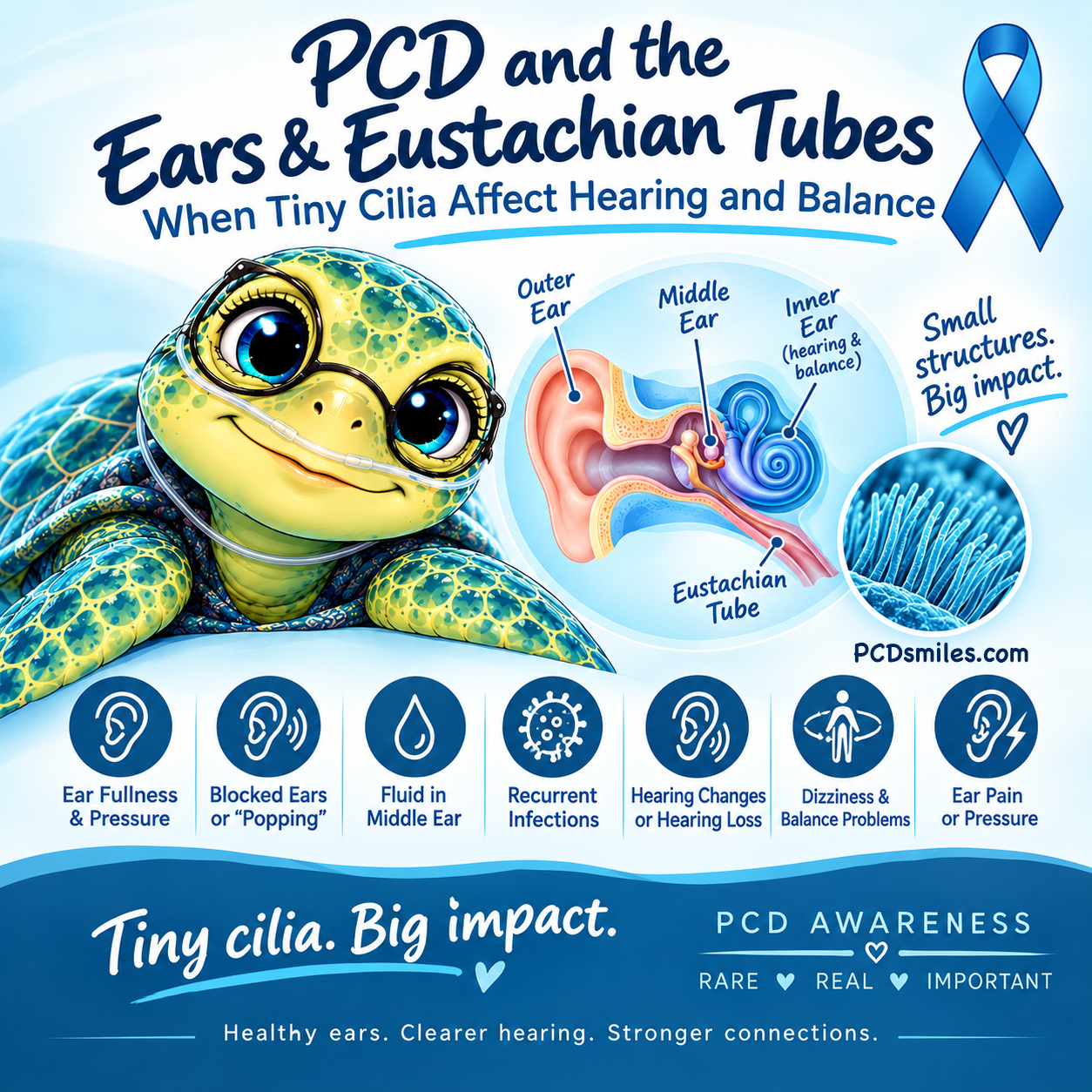
The ear is commonly divided into
three sections:
- Outer ear — collects sound.
- Middle ear — an air-filled space containing tiny bones that help transmit sound.
- Inner ear — involved in hearing and balance.
The Eustachian tubes connect the middle ear to the back of the throat.
These small tubes have several important jobs. They help equalize air pressure on both sides of the eardrum and help drain fluid from the middle ear.
Cilia lining the Eustachian tubes help move mucus and fluid away from the middle ear.
In healthy ears, this system helps keep the middle ear functioning properly.
In PCD, however, the cilia may not move mucus and fluid effectively.
How Does PCD Affect the Eustachian Tubes?
Think of the Eustachian tubes as tiny drainage and pressure-control pathways.
When the cilia are working normally, they help keep these pathways clear.
With PCD, abnormal ciliary movement can interfere with this process. The Eustachian tube may become blocked or inflamed, making it harder for the middle ear to drain properly or equalize pressure.
This can contribute to:
Ciliary dysfunction → impaired mucus movement → Eustachian tube blockage or inflammation → fluid buildup → ear symptoms
The problem isn't simply that the ear produces too much fluid.
It's also that the microscopic system responsible for moving fluid and mucus isn't working normally.
Fluid Buildup in the Middle Ear
One of the potential ear complications associated with PCD is fluid buildup in the middle ear, sometimes referred to as otitis media with effusion.
When fluid remains behind the eardrum, it can interfere with the normal transmission of sound.
This may cause:
- A feeling of fullness or pressure in the ear
- A sensation that the ear is blocked or "popping"
- Changes in hearing
- Recurrent ear problems
For some people, these symptoms may come and go. For others, persistent fluid can contribute to longer-term hearing difficulties.
Recurrent Ear Infections
Impaired mucus clearance can also contribute to recurrent ear infections.
When mucus and fluid aren't cleared effectively, microorganisms may have an environment in which they can remain.
People with PCD may therefore experience ear infections that are more frequent or more difficult to treat.
This doesn't mean every person with PCD will experience frequent ear infections. PCD affects people differently, and the severity of ear involvement can vary.
Hearing Changes
Hearing changes are another important part of PCD-related ear health.
Fluid in the middle ear can temporarily interfere with hearing. Repeated infections and ongoing problems can also contribute to more persistent hearing difficulties.
Hearing changes may therefore be:
- Temporary
- Recurrent
- Or, in some cases, long-term
Because hearing is so important for communication, learning, and quality of life, changes in hearing deserve attention—especially in children.
What About Balance?
The inner ear plays an important role in maintaining balance.
When the inner ear is involved, some people with PCD may experience dizziness or balance problems.
Balance symptoms aren't necessarily present in everyone with PCD, but they are an important symptom to recognize.
If someone with PCD experiences unexplained dizziness, balance difficulties, or changes in hearing, discussing those symptoms with a healthcare professional can help determine whether the ears or another factor may be involved.
Common Ear Symptoms in PCD
The poster highlights several symptoms that can occur with PCD-related ear involvement:
- Ear fullness or pressure
- A feeling of the ears "popping" or being blocked
- Fluid in the middle ear
- Recurrent ear infections
- Hearing loss or hearing changes
- Dizziness or balance problems
- Ongoing ear pain or pressure
Not everyone with PCD will experience all of these symptoms.
PCD affects everyone differently.
Why Healthy Cilia Matter
The difference between healthy cilia and dysfunctional PCD cilia may be microscopic, but the consequences can be noticeable.
Healthy cilia
Healthy cilia help:
- Move mucus and fluid.
- Keep the Eustachian tubes functioning.
- Support middle-ear drainage.
- Help maintain healthy conditions for hearing.
PCD cilia
With PCD, cilia may not move normally. As a result:
- Mucus and fluid may not clear effectively.
- Eustachian tubes can become blocked or inflamed.
- Fluid may accumulate in the middle ear.
- Ear infections may occur repeatedly.
- Hearing can be affected.
- Balance symptoms may occur when the inner ear is involved.
Tiny cilia. Big impact.
What Can Help?
Managing ear problems in PCD should be individualized and coordinated with a healthcare team.
Several approaches that may be part of care:
- Staying on top of the PCD care plan and treatments
- Treating infections early with guidance from a healthcare professional
- Managing allergies when they contribute to symptoms
- Using nasal rinses or humidification as recommended
- Having regular hearing checks and ear examinations
- Asking about support groups and resources
Regular monitoring can be especially important when someone has recurring ear infections, fluid buildup, or hearing changes.
Why Hearing Checks Matter
Hearing problems aren't always obvious.
A person may gradually adjust to reduced hearing without realizing how much their hearing has changed. Children may have difficulty recognizing or communicating that they're not hearing normally.
Regular hearing evaluations can help identify changes and provide an opportunity to address problems early.
For someone living with PCD, ear care shouldn't be an afterthought.
Healthy ears support clearer hearing, communication, learning, and connection with the world around us.
PCD Is More Than a Lung Disease
PCD is a genetic condition involving dysfunctional cilia, and those cilia are found in many places throughout the body.
In the ears and Eustachian tubes, their role in moving mucus and fluid is important for maintaining normal ear function.
When that microscopic movement is impaired, the effects can include:
Eustachian tube dysfunction → fluid buildup → recurrent infections → hearing changes
And for some individuals, problems involving the inner ear may also contribute to balance difficulties.
The important message is that ear symptoms shouldn't necessarily be viewed as unrelated problems when someone has PCD.
The Bigger Picture
PCD doesn't just affect the lungs.
It can impact the ears, Eustachian tubes, hearing, and balance as well.
Understanding this connection can help patients, families, and healthcare providers recognize ear symptoms as a potential part of PCD and make ear and hearing health an important part of comprehensive care.
If your ears frequently feel "off," pressure and fullness keep coming back, infections are frequent, or hearing seems different, it's worth bringing those symptoms up with your healthcare team.
Because sometimes the problem isn't simply the ear.
It may be the tiny cilia that are supposed to help keep everything moving.
Small cilia. Big impact.
Healthy ears. Clearer hearing. Stronger connections.
More awareness can lead to earlier recognition, better support, and better quality of life for people living with PCD.
Be sure to join us tomorrow for another conversation about primary ciliary dyskinesia.
Join our Facebook group Turtle Talk Café today.
We have several ways that you can donate to PCD Smiles;
- Visit Smile E. Turtle's Amazon Wishlist
- For more information on how you can donate, please visit our "Donation" page to check out our "Do & Don't policies.
- Or sponsor a PCD Smiles cheer package today!
- To shop for your “Official” turtle care ribbon gear today, visit PCD Style
Thank you for your consideration!
Medical Disclaimer
This article is intended for general educational and informational purposes only and is not a substitute for professional medical advice, diagnosis, or treatment. Infection risks and appropriate prevention strategies can vary considerably between people with PCD based on their lung health, respiratory cultures, treatments, age, and other medical conditions.
Cleaning and disinfection recommendations for respiratory equipment can also vary by device and manufacturer. Always follow the instructions provided by your healthcare team and equipment manufacturer.
Do not start, stop, or change medications, airway-clearance treatments, infection-control practices, or other aspects of your medical care based solely on this article. If you have PCD and are concerned about an infection, worsening respiratory symptoms, or possible exposure to a pathogen, contact your PCD or respiratory healthcare team for individualized guidance.
If you are experiencing severe or rapidly worsening breathing difficulties or another medical emergency, seek urgent medical attention.