

For most people, encountering bacteria in the environment is simply part of everyday life.
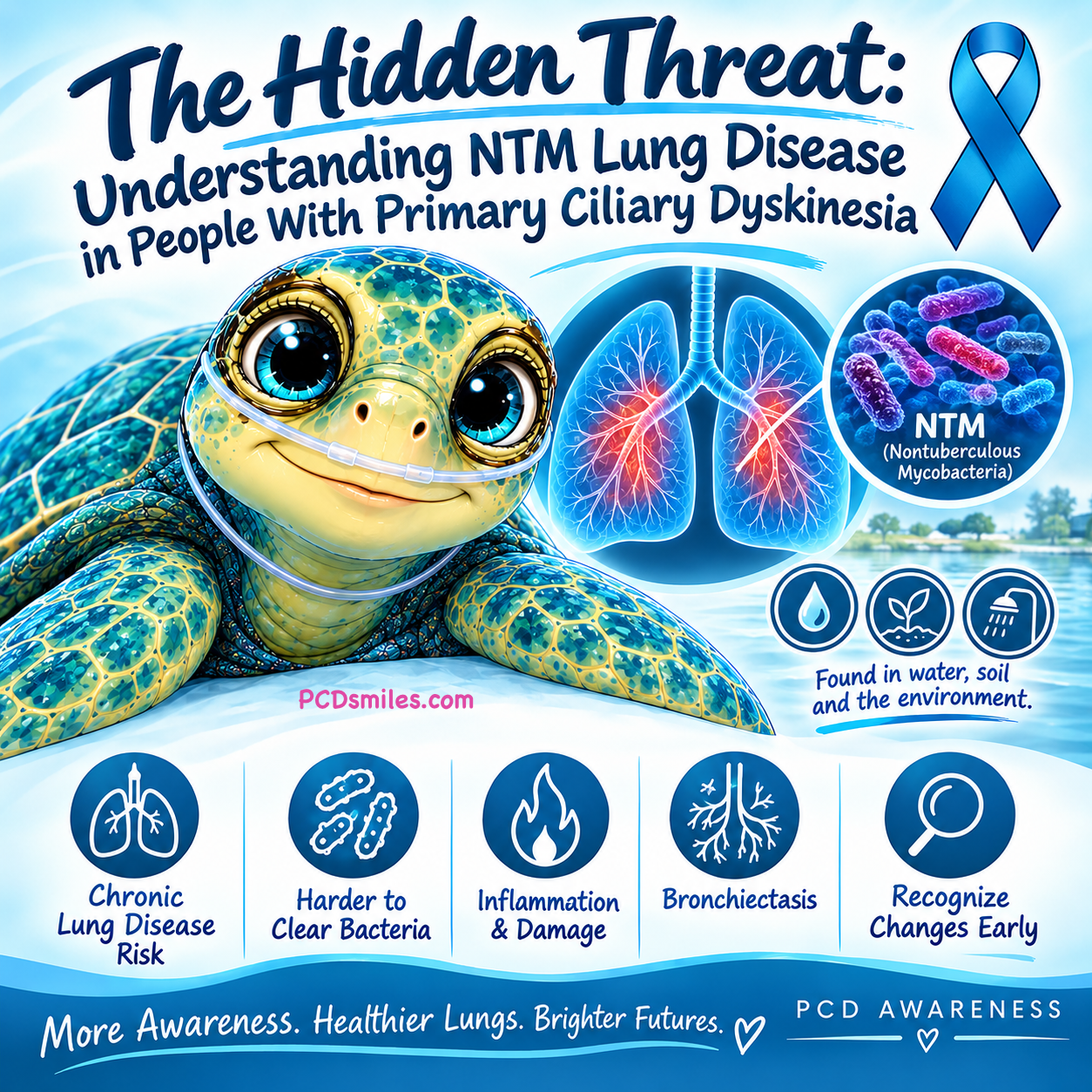
Nontuberculous mycobacteria (NTM) are found naturally in soil, dust, and water—including sources such as municipal water systems, plumbing, showers, and other wet environments.
For most healthy people, exposure to NTM does not result in lung disease.
But for people living with Primary Ciliary Dyskinesia (PCD), the story can be
different.
PCD already makes it difficult for the lungs to clear mucus, bacteria, and other particles. Over time, impaired mucus clearance can contribute to chronic infection, inflammation, and bronchiectasis.
That damaged and mucus-filled airway environment can make some people with PCD more vulnerable to difficult-to-treat organisms—including NTM.
And because the symptoms of NTM lung disease can look remarkably similar to an ordinary PCD exacerbation, recognizing the possibility matters.
What Exactly Is NTM?
Nontuberculous mycobacteria are a large group of environmental bacteria related to, but different from, the bacteria that cause tuberculosis (TB).
There are many different NTM species.
Two groups that are particularly important in lung disease include:
- Mycobacterium avium complex (MAC)
- Mycobacterium abscessus complex
NTM can be found naturally in the environment, particularly in water and soil.
Unlike tuberculosis, NTM lung disease is generally not considered a person-to-person contagious infection. People are typically exposed to NTM from their environment.
Exposure, however, does not automatically mean infection.
A person can encounter NTM without developing disease, and NTM can sometimes be detected in respiratory samples without necessarily causing active pulmonary disease.
That distinction is extremely important.
Why Does PCD Matter?
To understand the connection between PCD and NTM, it helps to understand what normally protects the lungs.
The respiratory tract has an elaborate cleaning system.
Mucus traps particles and microorganisms that enter the airways, while microscopic structures called cilia beat in coordinated waves to move that mucus toward the throat.
This process is called mucociliary clearance.
In PCD, the cilia don't function normally.
They may be missing, structurally abnormal, move incorrectly, or fail to coordinate their movement.
The result is impaired mucus clearance.
Instead of being efficiently moved out of the lungs, mucus can remain trapped in the airways.
Over many years, this can contribute to:
Mucus retention → recurrent infection → inflammation → airway damage → bronchiectasis
Once bronchiectasis develops, the airways can become permanently widened and structurally damaged.
That creates an environment in which certain microorganisms can persist.
And this is where NTM becomes particularly important.
PCD + Bronchiectasis + NTM: Why the Combination Matters
NTM is an opportunistic environmental organism.
It doesn't need to infect everyone it encounters.
But when the normal defenses of the lungs are compromised, the balance can change.
For someone with PCD and established bronchiectasis, impaired mucus clearance and structural airway damage may make it more difficult to eliminate organisms that reach the lower respiratory tract.
That doesn't mean every person with PCD will develop NTM disease.
They won't.
But it does mean that NTM belongs on the diagnostic radar when respiratory symptoms change or lung disease behaves differently than expected.
This is particularly important because PCD itself can produce many of the same symptoms as NTM.
The Symptoms Can Be Easy to Miss
Someone with PCD may already live with:
- Chronic cough
- Daily mucus production
- Recurrent respiratory infections
- Shortness of breath
- Fatigue
- Chronic sinus disease
- Bronchiectasis
Those symptoms can make it difficult to recognize when something new is happening.
NTM pulmonary disease can cause symptoms such as:
- A persistent or worsening cough
- Increased sputum production
- Fatigue
- Shortness of breath
- Reduced appetite
- Unintentional weight loss
- Low-grade fever
- Night sweats
- Occasionally, coughing up blood
But there is no single symptom that proves someone has NTM.
A change from a person's usual respiratory baseline is what deserves attention.
For someone with PCD, that might mean:
"My cough is different."
"My sputum has changed."
"I'm having more exacerbations than usual."
"My lung function is declining unexpectedly."
"I'm losing weight without trying."
"I'm not responding to treatment the way I normally do."
Those changes don't automatically mean NTM.
But they may warrant further investigation.
NTM Is Not the Same as an Ordinary PCD Infection
This distinction is particularly important.
People with PCD can develop respiratory infections from many different organisms.
Finding a microorganism in a sputum sample doesn't necessarily mean it is causing active disease.
With NTM, clinicians generally need to determine whether the organism represents:
Environmental exposure or contamination
versus
Colonization
versus
Actual NTM pulmonary disease
That's why diagnosis isn't based on a single positive sputum culture.
Healthcare providers typically consider a combination of:
- Symptoms and clinical history
- Repeated respiratory cultures
- Chest imaging, often including high-resolution CT
- Laboratory identification of the specific NTM species
The exact diagnostic process depends on the individual's circumstances and the clinical guidelines being followed.
A positive culture deserves appropriate evaluation—but it does not automatically mean someone has active NTM lung disease.
Why Multiple Cultures Matter
NTM can be complicated to interpret.
A single respiratory sample may detect an environmental organism that isn't actually causing progressive disease.
That's one reason clinicians often obtain multiple respiratory specimens when NTM is suspected.
Repeated detection of the same organism, combined with compatible symptoms and imaging findings, provides a much stronger indication that the organism may be contributing to active lung disease.
This careful approach is especially important because treatment for NTM can be lengthy and demanding.
Doctors don't want to expose someone to months of potentially toxic medications unless there is a meaningful reason to believe treatment is necessary.
The Two NTM Names PCD Patients May Hear Most
Mycobacterium avium Complex — MAC
MAC is one of the most commonly identified groups of NTM associated with pulmonary disease.
Treatment can involve multiple medications over an extended period.
The exact regimen depends on factors such as:
- The specific organism
- Drug susceptibility
- Severity of disease
- Imaging findings
- Symptoms
- Overall health
- Previous treatment
Mycobacterium abscessus Complex
M. abscessus can be particularly challenging.
It can have complex patterns of antibiotic resistance and may require prolonged treatment involving several medications.
Treatment decisions are highly individualized and are best managed by clinicians experienced in NTM pulmonary disease.
Treating NTM Is a Marathon
One of the hardest realities about NTM is that treatment can be long, complicated, and physically demanding.
Unlike many routine respiratory infections, NTM pulmonary disease may require multiple antibiotics taken over an extended period.
Depending on the organism and the individual circumstances, treatment can involve:
- Multiple oral antibiotics
- Inhaled medications
- Intravenous antibiotics in some situations
- Regular sputum cultures
- Blood testing
- Hearing or vision monitoring for certain medications
- Liver and kidney monitoring
- Repeated imaging
- Ongoing lung-function testing
Treatment plans vary significantly.
There is no universal NTM treatment regimen that applies to every person.
Airway Clearance Still Matters
For someone with PCD, treating the bacteria is only part of the equation.
The underlying problem with mucociliary clearance remains.
That's why maintaining an individualized airway-clearance routine can be an important part of managing chronic respiratory disease.
Depending on the person's treatment plan, airway clearance may involve:
- Breathing techniques
- Huff coughing
- PEP or OPEP devices
- Nebulized therapies
- Chest physiotherapy
- Oscillation and Lung Expansion
- High-frequency chest wall oscillation
- Other airway-clearance approaches
The goal is to help move mucus out of the lungs.
In some people with NTM, clinicians may also use inhaled therapies such as hypertonic saline to assist mucus clearance, but treatment should be individualized by the healthcare team.
Airway clearance does not replace antimicrobial treatment when treatment is indicated.
It is one part of a larger management strategy.
What About Showers, Faucets, and Household Water?
This is where NTM discussions can sometimes create unnecessary fear.
NTM can live in water and wet environments.
It can be found in plumbing systems, showerheads, and other environmental sources.
But that does not mean a person with PCD needs to fear taking a shower or attempt to create a completely sterile home.
Environmental exposure to NTM is extremely common.
The important point is that people with PCD and bronchiectasis may have different consequences from certain exposures than people with healthy lungs.
Questions about environmental precautions should therefore be individualized.
Someone with known NTM pulmonary disease or recurrent NTM infections may receive specific recommendations from their specialist regarding water exposure, aerosolized water, gardening, soil, or other environmental sources.
Those recommendations may differ from person to person.
PCD Makes Awareness Especially Important
PCD is already a complex disease.
Patients may spend years managing:
- Daily airway clearance
- Bronchiectasis
- Recurrent infections
- Sinus disease
- Ear disease
- Respiratory cultures
- Antibiotics
- Lung-function testing
- Hospitalizations and exacerbations
Adding NTM to that picture can be overwhelming.
But awareness can also be empowering.
Knowing that NTM exists means a person with PCD can recognize when something about their respiratory health is different from their usual pattern and discuss it with their healthcare team.
That doesn't mean assuming every worsening cough is NTM.
It means knowing that persistent or unexplained changes deserve investigation.
Protecting the PCD Lung
There is no way to eliminate every environmental microorganism.
And trying to do so would make everyday life nearly impossible.
Instead, the focus should remain on the things people with PCD can control:
- Maintain the prescribed airway-clearance routine.
- Keep regular pulmonary appointments.
- Provide respiratory cultures when your healthcare team recommends them.
- Monitor lung function over time.
- Take prescribed treatments as directed.
- Report significant or persistent changes in respiratory symptoms.
- Ask about NTM testing when your clinical situation makes it appropriate.
The goal isn't to live in fear of bacteria.
The goal is to recognize problems early and protect the lungs for the long term.
NTM and PCD: An Important Conversation
PCD doesn't automatically lead to NTM.
NTM exposure doesn't automatically lead to NTM infection.
And a positive NTM culture doesn't automatically mean active NTM pulmonary disease.
But for someone living with PCD—particularly someone with bronchiectasis—NTM is an important organism to understand.
PCD already compromises one of the lungs' most important natural defense mechanisms.
When mucus clearance is impaired and the airways become structurally damaged, certain environmental organisms can become more difficult to manage.
That is why unexplained changes in respiratory health should never simply be dismissed as "just PCD."
Sometimes the explanation really is another PCD exacerbation.
Sometimes it's a viral infection.
Sometimes it's a bacterial infection.
And sometimes, NTM may be part of the picture.
Recognizing that possibility can help ensure the right questions are asked, the appropriate testing is considered, and treatment decisions are based on evidence rather than assumptions.
PCD already makes clearing the lungs harder. Understanding NTM gives patients and families one more piece of the puzzle—and one more reason to pay attention when the lungs start telling you something has changed.
Be sure to join us tomorrow for another conversation about primary ciliary dyskinesia.
Join our Facebook group Turtle Talk Café today.
We have several ways that you can donate to PCD Smiles;
- Visit Smile E. Turtle's Amazon Wishlist
- For more information on how you can donate, please visit our "Donation" page to check out our "Do & Don't policies.
- Or sponsor a PCD Smiles cheer package today!
- To shop for your “Official” turtle care ribbon gear today, visit PCD Style
Thank you for your consideration!
Medical Disclaimer
This article is intended for general educational and informational purposes only and is not a substitute for professional medical advice, diagnosis, or treatment. Infection risks and appropriate prevention strategies can vary considerably between people with PCD based on their lung health, respiratory cultures, treatments, age, and other medical conditions.
This article is for educational purposes and does not establish that over-thinning mucus causes increased infection risk in people with PCD. Responses to airway-clearance and mucoactive therapies vary. Any changes to prescribed treatments should be discussed with a healthcare professional familiar with PCD.
Cleaning and disinfection recommendations for respiratory equipment can also vary by device and manufacturer. Always follow the instructions provided by your healthcare team and equipment manufacturer.
Do not start, stop, or change medications, airway-clearance treatments, infection-control practices, or other aspects of your medical care based solely on this article. If you have PCD and are concerned about an infection, worsening respiratory symptoms, or possible exposure to a pathogen, contact your PCD or respiratory healthcare team for individualized guidance.
If you are experiencing severe or rapidly worsening breathing difficulties or another medical emergency, seek urgent medical attention.